

What the EF? How to Support Time Management
When someone consistently struggles with time management, the outside world often interprets it as laziness, irresponsibility, lack of effort, or “not caring enough.” If perceived in this way, it leads to frustration, disappointment, and hurt for others and shame for the ADHDer. In reality, many of these challenges stem from ADHD-related differences in executive functioning, including time awareness, time estimation, attention regulation, task initiation, working memory, and energy management.
Support becomes much more effective when we stop assuming that the issue is a lack of planning ahead, and we actually break down and consider what cognitive skills and information is necessary to effectively time manage.
Let’s talk about what actually helps.

What the EF: Understanding Time Management
When most people hear “time management,” they think of planners, calendars, and color-coded schedules. But that’s only the surface. At its core, “good” time management requires being able to accurately estimate how long each task will take, and for many ADHDers, that’s where things start to get complicated.
Time isn’t something we can see or hold. It’s abstract. And when your brain already has difficulty regulating attention, motivation, and emotion, time can feel slippery and elusive.
Let’s break it down.

A Guide to Finding a Neurodiversity-Affirming Assessor
You’ve probably been here before. Typing “autism assessment near me” or “ADHD evaluation for adults” into Google… and immediately feeling a mix of hope, dread, and please don’t let this be another person who doesn’t get it. Maybe you’ve been dismissed before. Maybe you’ve been told you’re “just anxious.” Maybe you’ve gotten really good at explaining yourself in a way that makes other people comfortable—but leaves you feeling wildly misunderstood. Maybe you’ve spent years in therapy trying to fix something that never quite made sense in the first place. And now you’re here wondering if this could be the missing piece… while also bracing yourself for the possibility that it won’t be.
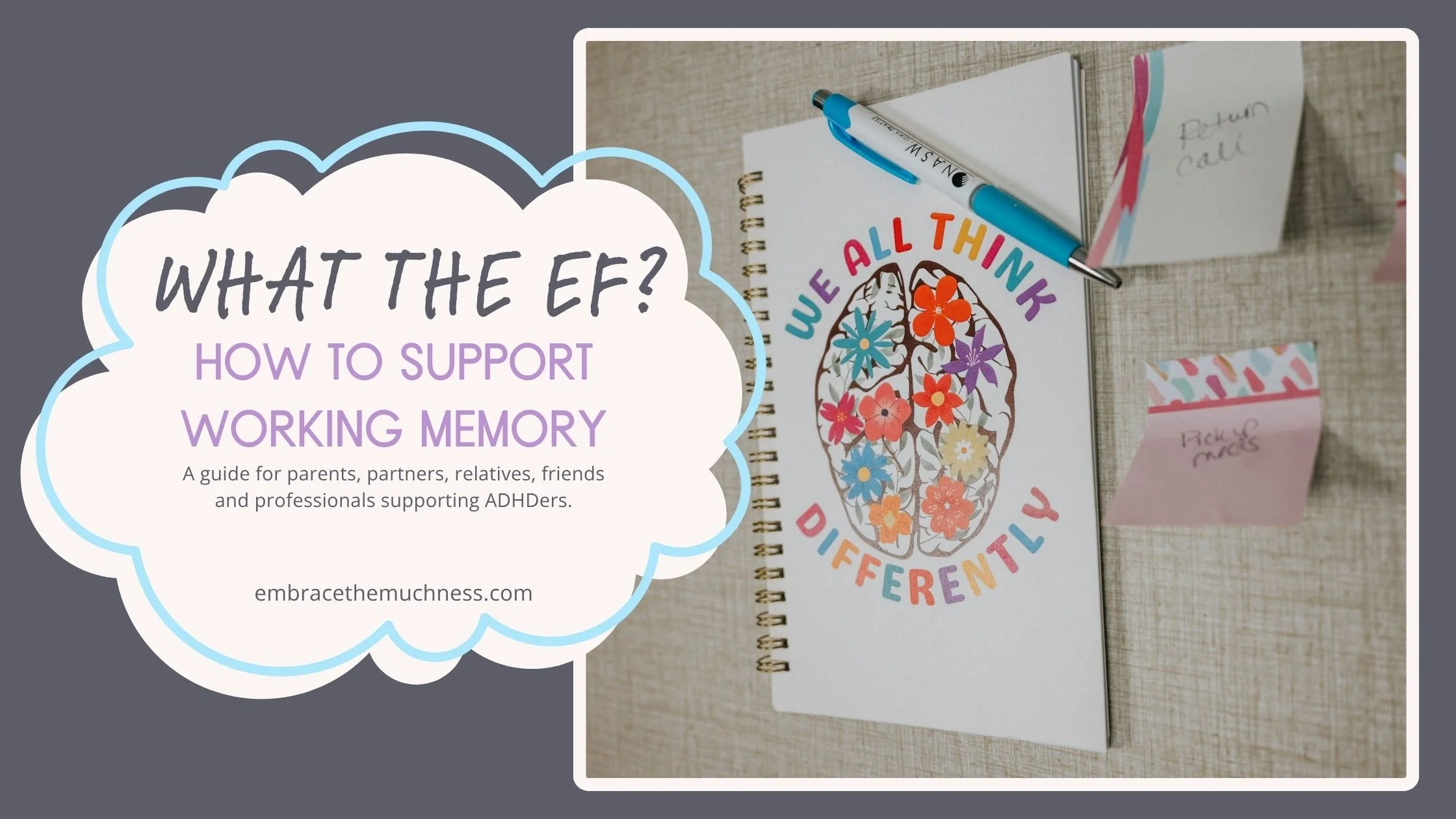
What the EF? How to Support Working Memory
A guide for parents, partners, relatives, friends and professionals supporting ADHDers. Part of the What the EF? Executive functioning blog series. /blog/tag/What+the+EF%3F
https://www.embracethemuchness.com/blog/understanding-working-memory
Before we begin, if you haven’t already read our companion blog, What the EF? Understanding Working Memory, we recommend reading that first and then returning.
If you’re a parent, partner, relative, friend, colleague, or professional supporting an ADHDer with working memory challenges, you’ve likely felt frustrated at times.
You might notice things like:
Important items getting lost
Needed items being forgotten when leaving the house
Tasks not being completed
Bills not being paid on time
Birthdays or anniversaries being ignored
Commitments not followed through on
Conversations not being remembered later
What the EF? Understanding Working Memory
Working memory…what does that even mean? For many ADHDers it feels like our memory is certainly not working! The term “working memory” refers to the cognitive skill of being able to temporarily store and manipulate information. Working memory is considered one of the executive functioning skills.
What Working Memory Actually Is
Think of working memory like a post it note in your brain. It tends to hold information temporarily until it’s needed.
Positive Notes for Kids: A 14-Day Connection Activity Parents Can Start Today
A low-effort activity that makes a big impact
A few years ago, I saw a post from HR Mom about a Valentine’s activity parents/caregivers could do for their kids that felt worthwhile and actually doable (even with my own executive functioning challenges) that could counterbalance some of the negative messaging my ADHD kids might receive from myself and others:
The Activity:
Write one thing you love about your child on a paper heart and hang it on their door each night from February 1st–13th.
What the EF? Understanding Executive Functioning Skills and ADHD
When people talk about ADHD, the conversation often centers on focus, attention, and impulsivity. As an ADHDer, a parent of ADHD children, and a professional who supports many ADHDers, I see executive functioning skills as the area where challenges show up most. These are the cognitive processes that help us “execute” tasks. Think of them like the executive of a business for your brain: they support goal setting, monitoring progress, following through, analyzing, and adjusting.
For search clarity: you may also see these challenges called “executive dysfunction” online. I use more affirming language here.
This article is an introduction to executive functioning and the eight core skills. It also kicks off a series where I will take a closer look at each skill and share strategies for people who experience challenges in that area.

Navigating Transitions with ADHD
Transitions, whether big or small, can be particularly challenging for both children and adults with ADHD. From starting a new school year to dealing with last-minute changes in your day, these shifts can disrupt your focus, organization, plan and overall sense of stability. With the right strategies, you can navigate these changes with a bit more ease. Let’s explore how to manage both major life transitions and everyday disruptions.

Helping Your Child Transition to College
Conversations to have before your student goes off to college. Review a list of suggested conversations parents can have with their students. Written by ADHD Coach & Educator, Bobbi-Jo Molokken.

Sign up for the “Muchness Matters” newsletter from Embrace the Muchness to receive a free ADHD/Neurodiversity Glossary & Acronym Resource!
Newsletter is sent 1-2x each month and includes ADHD education, resources, and updates on service offerings. You’ll also be notified every time the resource list is updated.